
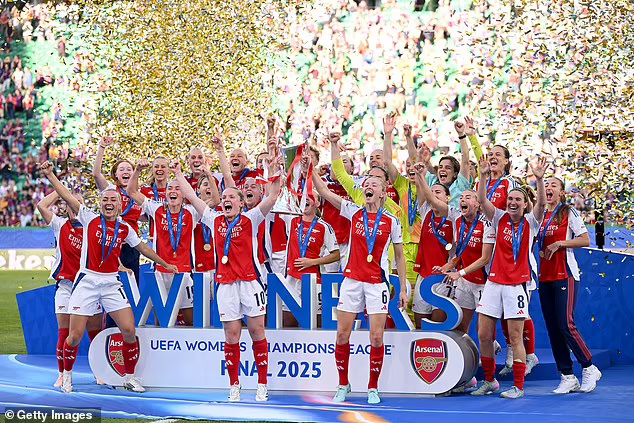
After 18 years, Arsenal are European champions once again. In a hard-fought battle against European giants and two-time reigning champions Barcelona, the Gunners pulled off the unthinkable with a classic 1–0 victory in Lisbon on Saturday, 24 May 2025.
The decisive goal came from super-sub Stina Blackstenius. Remarkably, this is the third consecutive final that Arsenal have won thanks to a match-winning goal from the Swede, a feat that earned her the Player of the Match award. But this was no solo effort; it was a heroic team performance from start to finish.
Leah Williamson was imperious at the heart of defence, never putting a foot wrong and constantly positioning herself in exactly the right place. Chloe Kelly and Caitlin Foord were relentless on the wings. They tormented the Barça backline and made crucial interventions in defence.
Barcelona’s formidable midfield, stacked with the likes of Alexia Putellas and Aitana Bonmatí, struggled to assert dominance. Arsenal’s experienced pairing of Kim Little and ex-Barcelona star Mariona Caldentey held their own, disrupting passing lanes and dictating the tempo.
At the back, Daphne van Domselaar stood tall, pulling off a string of world-class saves to secure a clean sheet in the biggest game of all.
It would be an injustice not to highlight the woman who transformed Arsenal’s season. From the club’s worst league start ever to a second European title, Renee Slegers has masterminded a remarkable turnaround.
Stepping up from assistant coach on an interim basis, Slegers inherited a team that was dejected and vulnerable. She brought clarity, belief, and fight. She was able to guide the squad back to its best. It’s never been easy, but under her leadership, Arsenal have rediscovered their identity. She’s managed to unlock something special in every single player.
This victory isn’t just about silverware. It’s about resilience, unity, and the quiet brilliance of a manager who refused to let the season fade away. This historic victory marks Arsenal Women’s second European title, reaffirming their status as the only English women’s team to ever lift the Champions League. A night for the history books. One that the red half of North London will never forget.

The Road To The Final
Qualifying
Arsenal had to go through a long qualifying process, after finishing 3rd in the WSL in the 2023/24 season.
In Round 1, a mini-tournament format saw the Gunners ease past Rangers with a commanding 6–0 victory, before edging Rosenborg 1–0 to book a place in Round 2.
Round 2 presented a tougher challenge: a two-legged tie against BK Häcken. After a shock 1–0 defeat in Sweden, Arsenal delivered emphatically at home, thrashing the Swedes 4–0 to progress and qualify for the Champions League. It was the first of many comebacks to come.
Group Stage
Arsenal were drawn in Group C, dubbed the group of death: Bayern, Juventus, and Vålerenga.
Our first game left fans stunning, as we suffered a 5-2 defeat in München. This would prove to be Jonas Eidevall’s last European game in charge of the Gunners, and one of his final. He stepped down a few weeks later, leaving a lot of questions regarding the future of the Arsenal managerial role.
But with Slegers at the wheel, Arsenal regained their composure. A dramatic comeback saw the Gunners top the group with resolute performances and newfound tactical clarity.
Her first game in charge was against Vålerenga, which Arsenal won convincingly, and with no real surprise.
The first real European challenge of her ability was a double header against Juventus. Again, Arsenal were victorious on both occasions: winning 4-0 away from home and 1-0 in North London.
Following another comfortable win against Vålerenga, it was then payback time. In the final group stage game to determine who would top the group, Arsenal faced Bayern again. This time, the difference in the team was visible. Arsenal won 3-2 with the winning goal coming from Alessia Russo. Arsenal finished the group top, progressing to the knock out stage.
Knock-Out Rounds
Quarter Finals: Real Mardid
Tough conditions in the Spanish capital left many of us shocked. In almost unplayable conditions, Real Madird managed to throw a spanner in the works. They won 2-0 thanks to two late goals.
Arsenal would have to do the unthinkable: score at least three goals to turn the tie around. A feat that had not yet been seen in the knock-out round of the Women’s Champions League.
Semi Finals: Lyon
Arsenal were drawn against eight-time European Champions Lyon. The first leg at the Emirates ended in a narrow 2-1 defeat. It was going to be a challenge to come back away from home. However, as this team has proven so many times under Slegers, nothing is impossible.
On a spectacular Saturday evening, the Gunners pulled off their biggest comeback yet securing a 4-1 win, 5-3 on aggregate and booking their spot in the final.
Both Alessia Russo and Mariona Caldenty finished the campaign with 7 goals each, joint second in the race for the Golden Boot.
What Does This Mean For Arsenal
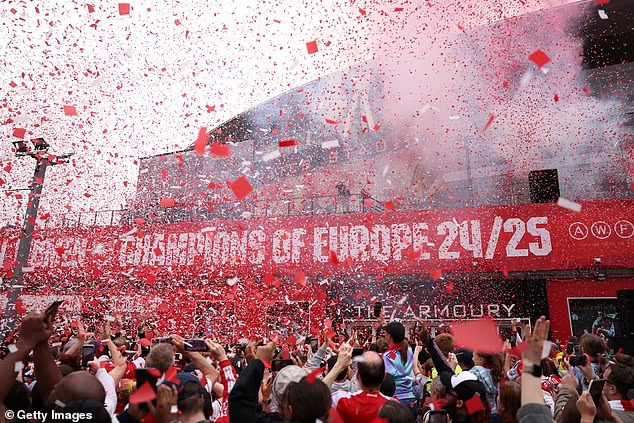
Arsenal remain the only English women’s team to have lifted a European trophy — and now, they’ve done it twice. Despite Chelsea’s recent domestic dominance, the Blues have yet to conquer Europe. Arsenal, meanwhile, etched their name into history first in 2007, and now again in 2025.
The Arsenal Women’s team is, by all measures, the most successful side in English football history. But in recent years, that legacy has come under threat. A lack of silverware has led to shifting narratives around who truly leads the women’s game in England.
This triumph changes that. It reasserts Arsenal’s status as European giants, and reaffirms their place at the top of the game. And coming at the end of a rollercoaster season, one marked by setbacks, change, and uncertainty, it feels all the more powerful.
Each player on the pitch had their own unique connection to the Champions League, and to this moment of triumph.
Captain Kim Little joined the club in 2008, just one year after Arsenal’s first European title. In her long and decorated career, she’s won everything there is to win. Except a European crown. Now, at last, that chapter is complete.
Leah Williamson was a mascot at the 2007 final, watching her childhood heroes lift the trophy. Yesterday, she was on the pitch. No longer a young fan, but a commanding vice-captain, dominating from centre-back with the poise and leadership we’ve come to expect.
Then there’s Chloe Kelly. After a difficult spell at Manchester City, she arrived on loan in January, openly struggling with form, fitness, and her love for the game. She had considered stepping away. Instead, she returned to North London, where rediscovered her spark. Yesterday, she worked tirelessly on the wing, a symbol of grit and rebirth.
And she wasn’t alone. Every player in red and white gave everything. For the badge, for each other, and for history.
And of course, Renee Slegers. A woman who not only stepped up, but completely turned Arsenal season around. From her position in the background of the clubs running, to the leader and mentor who guided them to the most prestigious trophy in European football.
This isn’t just a trophy. It’s a statement. Arsenal are back and they belong at the summit of European football.
 Ladies In Red
Leave a comment